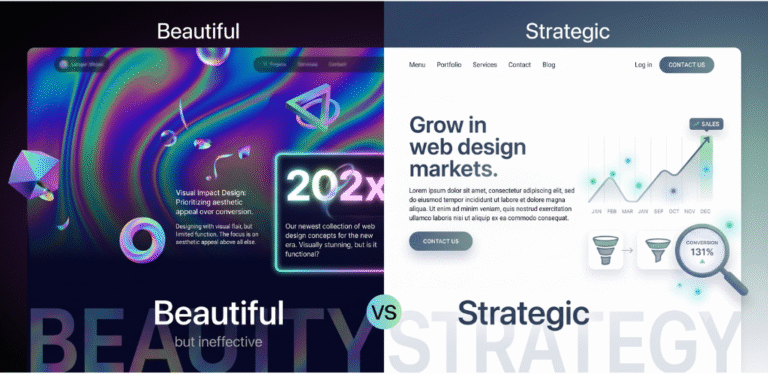
Every year, countless articles appear about “the latest web design trends.” Think of bright gradients, striking animations, heavy 3D elements, or experimental typography. But the reality is that many of these trends have little to no impact on the commercial success of a website.
In 2026, web design is less of an aesthetic choice and more of a strategic business decision. The question is not: what is new? The question is: what actually drives results? Design must support your conversion, lead generation, and business growth.
1. Strategic Minimalism: Less, but More Focused
Minimalism has been popular for years, but in 2026 we see a clear shift from “visual minimalism” to “strategic minimalism.” This means not just having fewer elements, but making deliberate choices to guide the visitor’s focus.
Visitors have little patience. They scan pages and want to quickly understand what a business does. Websites that show too much information at once lose attention instantly. Strategic minimalism focuses on:
Clear hierarchy in headlines and body text,
One primary action (Call-to-Action) per section,
Deliberate use of whitespace and breathing room,
Eliminating redundant graphic decorations.
2. Conversion-Driven Design as Standard
In 2026, conversion rate optimization (CRO) is no longer a separate discipline alongside design; it is integrated at its core. A modern B2B website is not designed around “what looks good?”, but rather “what action should this page drive?”
This translates to:
Clear value propositions placed directly above the fold,
Highly visible and strategically placed call-to-actions,
Eliminating friction and doubt through transparent customer reviews.
Instead of a generic button saying “Learn more”, we see concrete call-to-actions like “Request a Free Design Proposal” or “Contact Us”. Every element has a job to do.
3. Speed as a Design Criterion
Speed in 2026 is a critical design decision. Where complex animations and heavy visual effects were once popular, performance is now the absolute priority. If a page does not load within a few seconds, bounce rates spike. A fast-loading website instantly communicates professionalism and trustworthiness.
4. Mobile-First Approach
Websites are no longer designed primarily for desktop and then “adjusted” for mobile. The mobile experience is the baseline. This affects the length of text blocks, the sizing of buttons, and the navigation structure. The focus required for a strong mobile layout ultimately improves the desktop experience as well.
5. AI-Assisted but Authentically Distinct
While AI tools accelerate layout generation and coding, the real trend in 2026 is differentiating your brand from generic, automated websites. In a market where competitors use the same tools, an authentic visual identity, unique tone of voice, and custom photography are more critical than ever.
6. Trust as a Foundation
Online visitors have become highly skeptical and compare options quickly. A website must demonstrate within seconds who you are, what you do, and why you are trustworthy. Clear contact info, transparent pricing/communication, and visible case studies are essential to eliminate user friction.
7. Data-Driven Optimization
A modern website is never truly “finished”. Through data analysis, A/B testing, and user insights, pages must be continuously optimized. Adjusting headlines, form fields, and conversion paths based on user data yields much better results than a one-time launch with no follow-up.
Conclusion: What Really Works in 2026?
Web design in 2026 is about effectiveness. Not about visual spectacles, but about clarity, speed, conversion, and trust. A website is not a decoration; it is a strategic engine to achieve your business goals.
NeurogenAds gebruikt cookies om je surfervaring te verbeteren, websiteverkeer te analyseren en gerichte advertenties te tonen. Door op "Accepteren" te klikken, ga je akkoord met ons gebruik van cookies.